


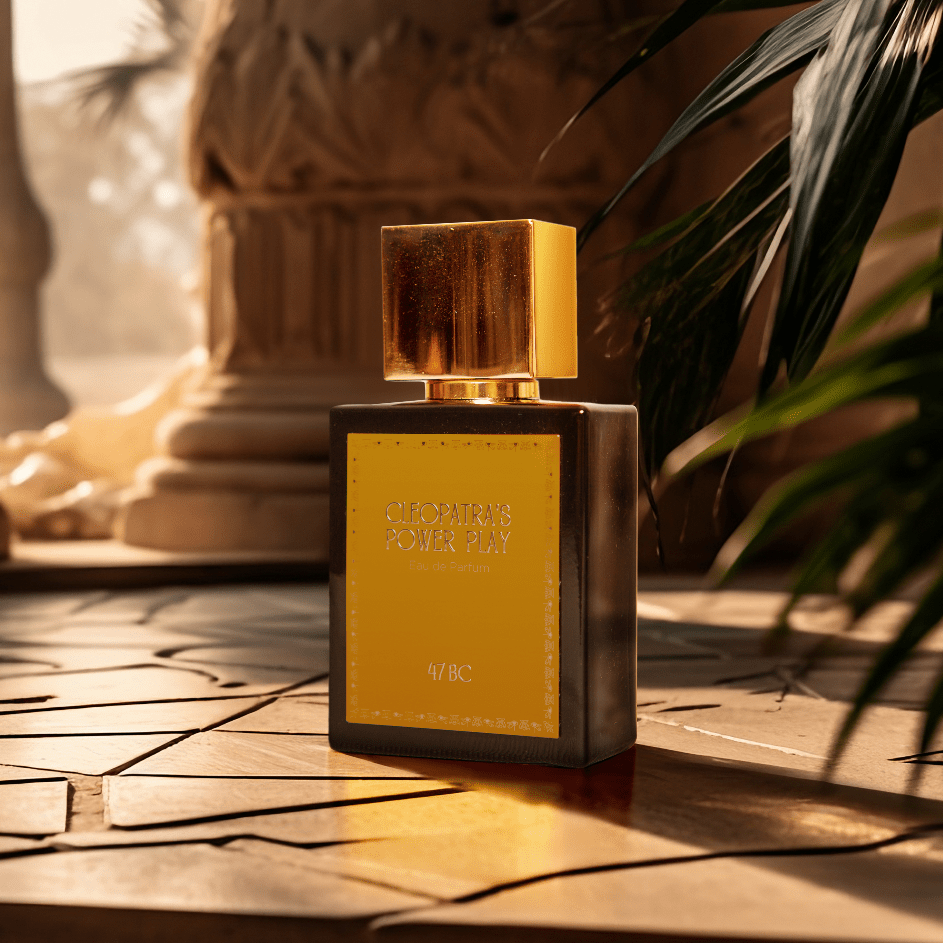


47 BC
Cleopatra’s Power Play
Eau de Parfum, 50ml
The olfactory portrait shows the moment when the deep sensuality of the moment mixes with tough pragmatism. An alabaster texture, meticulously crafted through white musks complemented by sweet resins, exotic woods, and milky accords, harmonizes with vibrant green, dewy notes of palm leaves, accompanied by fruity nuances of dates and pomegranate.
Chronicle
47 BC
Ptolemaic rule over Egypt depends heavily on the influence of the Roman Republic. The legacy of the Egyptian kingdom lies in the hands of siblings – Cleopatra VII and Ptolemy XIII. Although the Queen's ambitions are vast, her younger brother exiles her shortly after coming of age.
There is only one hope for the unbroken Queen and she must aim high. Gaius Julius Caesar – one of the most extraordinary strategic minds yet to be conquered – resides in Alexandria's Great Palace. Yet the Roman general is also not a welcomed guest. Egyptians understand subtle diplomatic rules, but they wish to have the foreign dictator further away: preferably in Rome.
Like desert sands under a restless Egyptian sun, this opportunity can rapidly shift into a deadly trap for the banished Cleopatra. But much like Caesar himself, the power of her intellect does not accept the possibility of this hostile reality. Determined to reshape fate on her own terms, Cleopatra sets the stage for what will become the most significant affair in ancient history.
To avoid capture by her brother’s forces, young Cleopatra enters Alexandria’s Palace rolled up in a linen cloth. Disguised as a merchant, her servant unrolls the "Father-Loving Goddess" in front of Caesar, allowing an almost theatrical setup to enter its final act.
Whether through a lens of great minds connected by brilliance, an instant spark of true love, or even spontaneous desire, Cleopatra flawlessly rushes for her goals on that warm October night. Soon after, Ptolemy is killed, and Cleopatra reclaims her merited throne.
Olfactive Interpretation
Alexandrian ruse:
Temptation:
myrrh incense, cinnamon
Long live the Queen:
When composing Cleopatra's Power Play, we knew that the most important element would be to adequately portray the dynamics of an event in which romance is the foundation of a fundamentally political game.
In phase one, we wander along with Cleopatra's character. We glide with a light step through the palace garden on the island of Antirhodos, where we are struck by the luscious, tropical greenery of palms and the aroma of dates. Soon we approach the place where Caesar resides. In this phase, a duet of jasmine and peony with a delicate, milky background becomes the focal point of the composition, laying an unobtrusive foundation for a story of risky seduction. However, this is not an immature, playful flirting. The chord is broken by hints of myrrh and cinnamon, providing an equally masculine counterbalance to the feminine focal point. The deepened perspective simultaneously underscores the enormous stakes of this intimate game.
A short time later, Cleopatra emerges from the palace at Caesar's side. She walks proudly among the tall alabaster columns; no longer as an intruder, but an ally, and soon - the ruler of Egypt. The scent’s dry-down, based on creamy sandalwood and warm resins emphasizes the royal, elegant interiors of the Ptolemaic palace.
The composition is moderately light, exotic, freshly green at first, moving later into floral-oriental regions, avoiding Arabian connotations. Instead, we tried to show a spacious background - juicy at first, then milky and woody. At the same time, it also has a certain dimension of simple, ancient elegance, which can be identified with the aristocracy of ancient Egypt.

